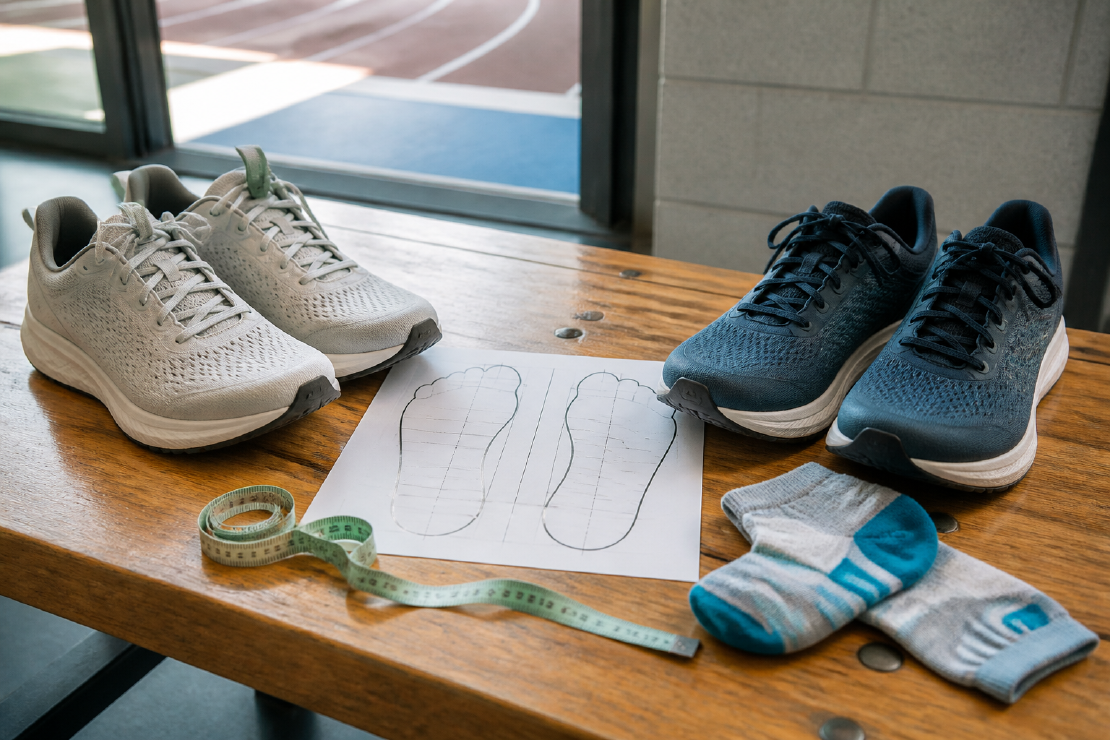
A useful running-shoe assessment considers both feet, comfort and stability at running pace, the intended surface and the planned training. A brief arch or walking assessment provides only part of that information.
Pronation is normal movement. It is not automatically a defect that needs to be blocked with a “support” shoe.
Fit both feet
Feet are often slightly different sizes. Fit the larger one and check the shoe while standing, then running if the shop allows it.
Look for:
- enough length that toes do not hit the front on descents;
- a heel that stays secure without crushing the Achilles area;
- no pressure point across the widest part of the forefoot;
- room for the toes to spread naturally;
- lacing that holds the midfoot without needing to be painfully tight.
A shoe described as likely to loosen with use should still be comfortable during the initial fitting. Materials may soften, but the underlying shape still needs to match the foot.
Record the fit, not only the size number
Measure both feet while standing, in the socks normally used for running. Use millimetres where possible: size labels and width names are not consistent between brands or even between models.
| Check | Left foot | Right foot | What to verify in the shoe |
|---|---|---|---|
| Foot length | ___ mm | ___ mm | Toes do not contact the front while running or descending |
| Widest forefoot point | ___ mm | ___ mm | No side pressure; toes can spread |
| Heel hold | — | — | Secure without rubbing or excessive lace tension |
| Midfoot pressure | — | — | Held in place without numbness or a pressure ridge |
Use the manufacturer’s current size chart to choose a starting size, then verify it on foot. There is no dependable universal conversion from a foot measurement to every brand’s labelled size.
Treat the wet-foot arch test as limited information
Arch height and footprint shape do not reliably tell a runner which shoe to buy. The American College of Sports Medicine specifically advises that foot shape or arch height should not determine shoe selection.
That also means a flat-looking footprint is not an automatic order for maximum stability, and a high arch is not proof that a runner needs the softest neutral shoe.
Walking analysis is not running analysis
Movement changes with speed. ACSM warns against buying a shoe because someone watched the customer walk: gait and foot motion differ while running.
Even treadmill video should be treated as one piece of information, not a diagnosis. A short clip without training history, pain history, pace and fatigue says less than confident sales language suggests.
If there is persistent pain or a recurring injury, see an appropriately qualified clinician. Buying a more controlling shoe is not a substitute for assessment.
Comfort is useful evidence
Compare several shoes without looking at the price or category first. Run briefly in each at an easy pace and, if relevant, at the pace the shoe is intended for.
Ask:
- Does the shoe disappear underfoot, or am I immediately correcting around it?
- Does the heel feel planted when turning?
- Does the forefoot bend where my foot bends?
- Is the cushioning comfortable rather than merely soft?
- Is any edge rubbing now?
The colourway is allowed to matter after the shoe passes these tests.
Match the job
| Main use | What matters most |
|---|---|
| Easy road running | Comfortable fit, predictable ride, durability |
| Fast sessions | Lower weight and a geometry that works at speed |
| Trails | Outsole grip, foothold, protection, drainage |
| Mixed walking and running | Comfort at both paces, stable heel |
| Travel | Versatility and an upper that dries reasonably |
A carbon-plated racing shoe can be excellent at racing and annoying for slow daily mileage. An aggressive trail outsole can be secure in mud and unpleasant on pavement. “Better” has no meaning without the job.
Buy for current training
Buy for current running rather than a speculative training plan six months away. One comfortable daily shoe may be enough for a new runner to learn which features and fit work well.
A recommendation from another runner does not replace an individual fit check. Shoe width should match the wearer’s foot rather than the pace associated with the model.
When to replace them
There is no exact universal mileage. Foam, outsole, runner mass, gait, surface and rotation all change wear.
Replace or demote a pair when:
- the midsole feels noticeably flat or unstable compared with another pair;
- the outsole is worn through in a way that changes contact;
- the upper no longer holds the foot securely;
- a repeatable discomfort appears in that pair and not in others;
- structural damage affects the ride.
Cosmetic creasing is not failure. A dirty upper is not failure. An arbitrary number in an app is not failure.
The shop checklist
- Bring the socks normally used for running.
- Fit the larger foot.
- Try several shapes, not only several models from one brand.
- Run, do not only stand and walk.
- Reject immediate pressure or instability.
- Choose for the real surface and pace.
- Check the return policy before using the shoe outside.
Running shoes are equipment, not a personality test. Start with fit and comfort. Add specialist features only when a real training need justifies them.