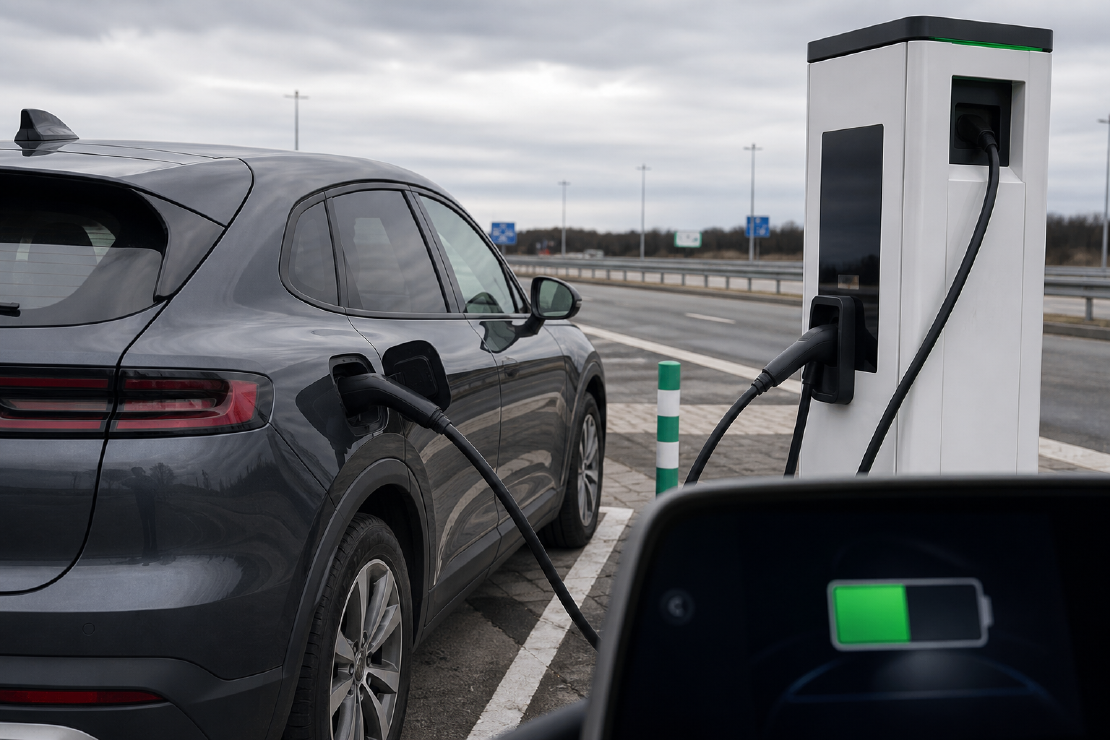
DC fast charging can add battery stress, especially at high charge rates, low temperatures and high states of charge. That is not the same as saying an occasional motorway fast charge will ruin the battery.
The car controls charging power continuously. The number printed on the charger is a maximum, not a command forced into the battery.
Why fast charging can be harder on a battery
Lithium-ion battery ageing is affected by more than charger type. National laboratory research considers temperature, state of charge, depth of discharge, charge rate, storage conditions and time.
Very high charging rates can contribute to heat and, under unsuitable conditions, lithium plating. NREL describes lithium plating as lithium attaching to graphite particles rather than being stored normally in the electrode, which can accelerate degradation.
The risk is not constant. Charging a cold battery hard is different from charging a warm, actively managed pack. Charging from 10% to 50% is different from forcing the final part toward 100%.
Why the charging speed falls
Most EVs charge fastest at a relatively low state of charge, then reduce power as the battery fills. This taper is deliberate.
It means a charger capable of 350 kW will not deliver 350 kW throughout the session, and a car with a lower peak cannot use the charger’s full rating. Near the top of the battery, waiting becomes slower while the vehicle protects the pack.
For road trips, charging past the point where speed drops sharply is often worse for both battery stress and journey time. Leaving earlier for another charger can be faster than filling to 100% at every stop.
Estimate the charging window
The calculator below shows the energy represented by a selected state-of-charge window and the ideal time at a chosen power. The battery bar is a visual reference for the part of the pack being filled.
EV charging-window estimator
Enter usable battery capacity, the charging window and the power the car is actually accepting.
This is an energy calculation, not a prediction of a specific car's charging curve. DC charging power normally changes during the session, especially near a high state of charge.
The calculation runs locally in your browser. Nothing is submitted or stored.
For a real journey estimate, use the vehicle’s measured charging curve or its route planner. Peak power is not a suitable input unless the car can sustain it across the chosen window.
Occasional use is different from constant use
An NREL simulation of realistic fast-charging access found minimal degradation impact for most drivers because use was infrequent. It also found thermal management important, particularly when packs lacked active cooling and fast charging was used heavily.
The result does not mean fast charging has no effect. Vehicle design, chemistry, climate and usage differ. It does show that an occasional fast charge should not be treated as automatic permanent damage.
Charging habits that can help
Battery care can focus on a few repeatable habits rather than rigid percentage rules.
- Use home or slower AC charging when it already fits the schedule.
- Use DC fast charging when the trip requires it.
- Let route planning or navigation precondition the battery when the vehicle supports it.
- Avoid leaving the car at a very high charge for a long period when it is unnecessary.
- Charge to the level required for the next leg rather than automatically chasing 100%.
- Follow the manufacturer’s storage and charge-limit guidance for the specific vehicle.
- Treat persistent heat, unusually low charging speed or warnings as a vehicle issue that may require the manual, manufacturer support or qualified service.
Habits with limited evidence or benefit
These tend to create inconvenience without a clear benefit:
- avoiding every fast charger even when a journey requires one;
- unplugging at an exact percentage regardless of next-day needs;
- comparing cars only by peak charging number;
- assuming a low session speed proves battery damage;
- cooling a battery by improvising around the manufacturer’s thermal system;
- treating one universal charge limit as correct for every chemistry and vehicle.
The vehicle manual matters because manufacturers use different cells, buffers, thermal systems and charge strategies.
Why a fast charger may run slowly
A disappointing session can come from:
- a cold battery;
- a battery already near full;
- the car’s own charging limit;
- a charger shared between stalls;
- site power limits;
- battery temperature after sustained driving;
- charger or vehicle faults.
Peak speed is useful for marketing. A charging curve—the power accepted across the session—is more useful for planning.
Should a home charger be slower for battery health?
Normal AC home charging is already far below motorway DC fast-charging power. Selecting an unnecessarily slow home rate may not provide a meaningful advantage, while it can prevent charging inside a cheap tariff window.
Use a rate that fits the electrical installation, tariff and required departure time. The bigger battery-health priorities are usually avoiding excessive heat, following vehicle guidance and not keeping the pack at unsuitable extremes for long periods.
The practical answer
Fast charging is a tool. Heavy, poorly managed exposure can contribute to degradation, while occasional use in a modern thermally managed EV is generally a normal part of operation.
Use it when the journey requires it, charge to a sensible margin for the next leg and follow the vehicle manufacturer’s battery guidance.