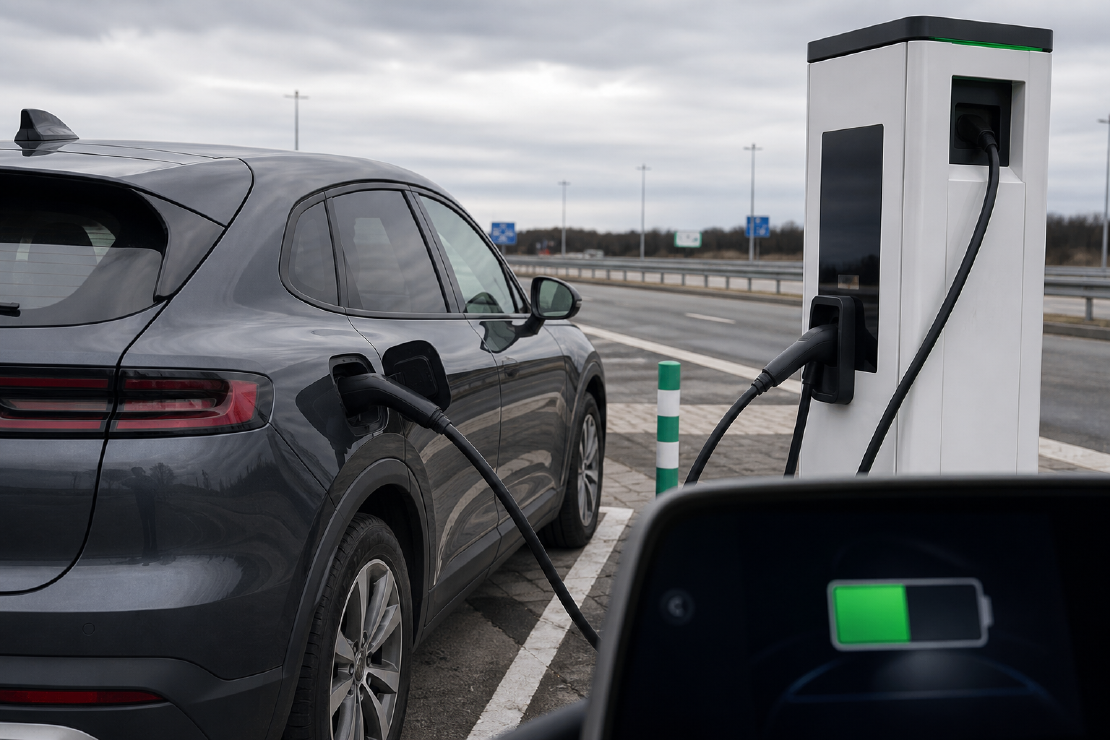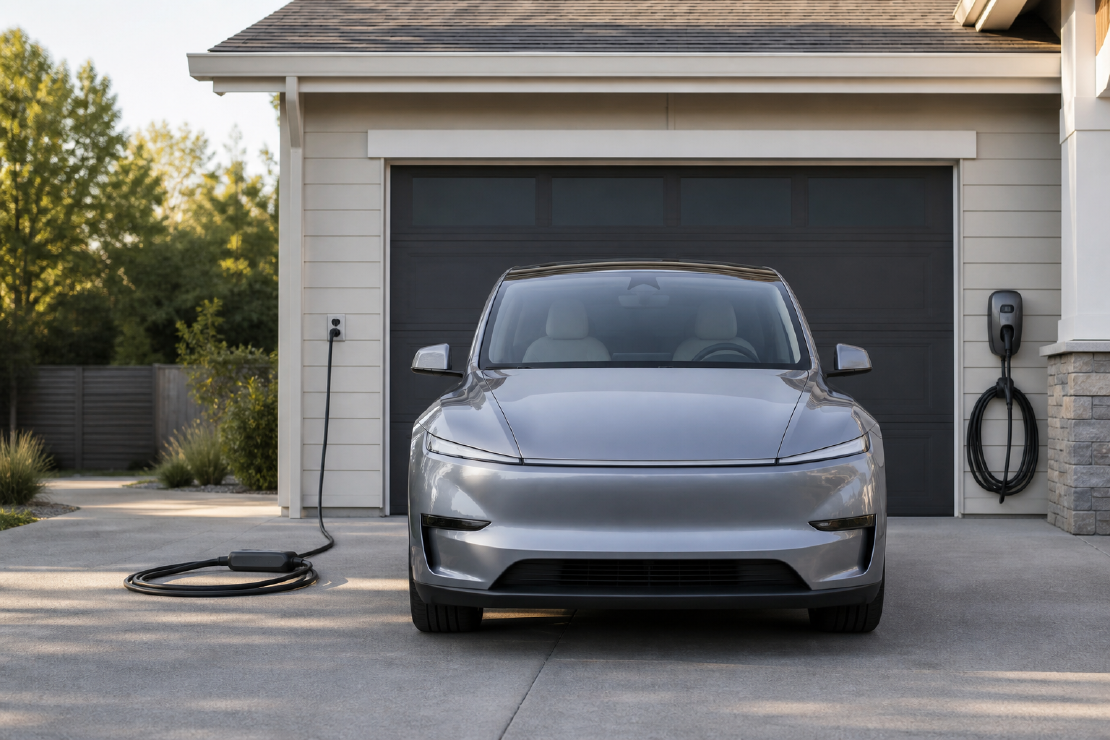
Level 2 is faster. That does not mean every EV owner needs it.
The useful calculation is how much driving must be replaced during the hours the car is normally parked. If a standard outlet restores more energy overnight than the car uses most days, an expensive charger installation may solve a problem that does not exist.
Start with daily energy, not battery size
Use the car’s real efficiency and normal daily distance:
daily charging need = daily distance × energy consumption per mile or kilometre
For example, a car using 18 kWh/100 km over a 50 km day needs about 9 kWh returned to the battery, plus charging losses. The full battery capacity matters mainly after an unusually long trip. It should not dominate a decision based on ordinary commuting.
Compare charging time with the parking window
Use the actual usable battery capacity and the charge window you expect to use. Try the calculator with the power available from each installation option. A nominal circuit rating is not necessarily the power delivered to the battery.
Home charging-time estimator
Compare an expected charging window with the time the car is normally parked.
The result is an ideal energy estimate. The car, cable, supply, temperature and charge-management settings may reduce power. Use a qualified installer for electrical decisions.
The calculation runs locally in your browser. Nothing is submitted or stored.
If the result fits comfortably inside the normal parking period, more charging power may not improve daily use. Check the occasional worst case separately rather than sizing the installation around it automatically.
What Level 1 is good at
In North America, Level 1 normally means charging from a standard 120 V household outlet. The US Alternative Fuels Data Center says it can cover a smaller plug-in hybrid or a partially depleted battery-electric vehicle overnight. It can work well for:
- low daily mileage;
- a plug-in hybrid;
- a car parked for ten or more hours most nights;
- a household with workplace charging;
- a temporary setup while actual usage becomes clear.
The outlet must be suitable for continuous use and the circuit must be assessed properly. An old outlet, improvised extension lead or unknown shared circuit is not a cheap charging plan. Follow the vehicle and charging-equipment instructions and use a qualified electrician where required.
What Level 2 changes
Level 2 uses a higher-voltage circuit and normally restores energy much faster. It becomes useful when:
- daily driving exceeds what Level 1 can replace overnight;
- two EVs share limited parking time;
- cheap off-peak electricity is available for only a short window;
- the car regularly returns nearly empty and must leave again soon;
- cabin or battery preconditioning needs to draw substantial power while plugged in;
- the household wants reliable recovery after long trips.
The benefit is not “charging from zero to full every night.” Most drivers do not arrive at zero, and a full charge is not required for the next day.
Installation cost is more than the charger
Price the complete job:
| Item | What to check |
|---|---|
| Electrical capacity | Existing service and panel headroom |
| Cable run | Distance from panel to parking space |
| Groundwork | Trenching or outdoor routing |
| Equipment | Hard-wired or plug-in unit, weather rating |
| Permits | Local inspection requirements |
| Load management | May avoid an expensive service upgrade |
| Tariff | Whether a dedicated meter or smart charger is required |
The charger advertised at a reasonable price can become the smallest part of a difficult installation. Get the electrical assessment before buying equipment.
A bigger circuit is not always better
Installing the maximum power the car can accept is often unnecessary. Charging power can be limited by the vehicle, the equipment, the circuit or the site’s electrical capacity. A modest Level 2 setup may easily refill normal daily use overnight.
Paying for a major service upgrade to save hours while everyone is asleep is poor value unless the household genuinely needs those hours.
Include the tariff
Charging at night can be cheaper under a time-of-use plan, but the household’s other electricity use matters. A tariff that makes EV charging cheap can make cooking, heating or daytime air-conditioning expensive.
Compare the whole bill, not the promotional EV rate. If the low-price window is short, Level 2 may recover its installation cost by moving more charging into that window. If electricity costs the same all day, speed alone creates no energy saving.
Renters and shared parking
Do not buy a portable unit before confirming:
- permission from the owner or building manager;
- who pays for installation and removal;
- how electricity will be measured;
- whether the parking space can change;
- cable safety and accessibility;
- what happens when another resident buys an EV.
Shared charging with fair billing can be better than one dedicated high-power circuit per space.
The sensible order
- Track real daily driving for a few weeks.
- Estimate the energy that must be replaced overnight.
- Check available outlets and electrical capacity.
- Compare tariffs.
- Price a modest Level 2 installation and any load-management option.
- Buy faster equipment only when the use case requires it.
Level 1 can be sufficient for some driving patterns, while Level 2 can provide useful recovery speed for others. The decision should be based on daily energy use, parking time, the electrical installation and tariff constraints.