Some switched-off devices still use electricity. The useful response is to measure the larger continuous loads and change only the ones that justify the effort.
Measure first. Target equipment that draws meaningful power for long periods and does not need to remain available. Leave safety, networking and essential scheduled equipment alone unless you understand the consequence.
Start with likely groups
Standby waste is often a system problem rather than one phone charger.
Check:
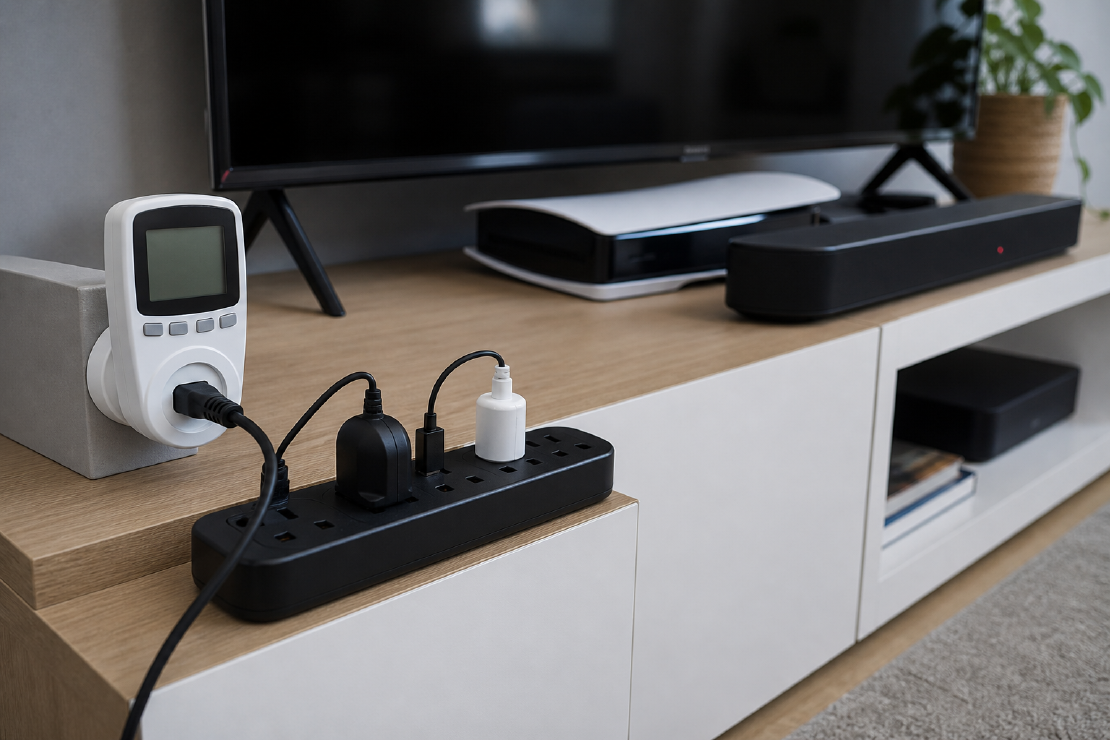
- television, soundbar, game console and set-top box together;
- desktop computer, monitors, speakers and printer;
- older audio equipment;
- guest-room electronics used a few days a year;
- workshop tools with permanently powered chargers;
- kitchen devices with displays or network connections;
- anything warm while apparently idle.
A single low draw may be irrelevant. Several devices operating 24 hours a day can justify a switched strip or settings change.
Use a plug-in electricity meter
A basic meter between the wall and appliance is more useful than lists of generic wattages.
Measure:
- normal use;
- immediate “off” state;
- standby after several minutes;
- a full day if the device wakes periodically;
- the whole power strip where equipment works as a group.
Some meters are inaccurate at very low power. Treat tiny readings as approximate and focus on clear, repeatable loads.
Annual energy is:
standby watts × hours per day × 365 ÷ 1000
A steady 10 W load uses about 87.6 kWh per year. Multiply by the actual electricity rate to get cost. A 0.2 W load uses about 1.75 kWh per year, so the practical saving may be too small to justify a daily manual step.
Standby electricity cost calculator
Use a measured wattage, the hours spent in standby each day and the price on your electricity bill.
Use the same currency unit as the electricity rate. Measure devices in their normal low-power state; a brief reading may miss cycling equipment.
The calculation runs locally in your browser. No readings or results are transmitted or stored.
Calculate a group of devices together when they will share one switched strip. Compare the annual saving with the price and standby draw of any control device you plan to add.
Change settings before buying gadgets
Look for:
- console instant-on modes;
- television quick-start;
- network wake features;
- automatic sleep on computers and monitors;
- scheduled printer wake-up;
- amplifier auto-standby;
- charger or dock lights that indicate the device remains active.
A lower-power mode keeps convenience without another product in the wall.
Where a switched strip helps
Use a normal switched strip when several devices can turn off together. A television setup is a good candidate if cutting power does not break recordings, updates or settings.
A smart or master-controlled strip can turn peripherals off when the main device sleeps. It is useful only if its own standby draw and behaviour are better than the problem it replaces.
Label the switch so that everyone who uses the equipment understands what it controls.
What not to disconnect casually
Be careful with:
- routers and network equipment needed by alarms or cameras;
- medical devices;
- refrigerators and freezers;
- smart-home hubs controlling safety functions;
- devices performing firmware updates;
- battery maintainers required by equipment instructions;
- recorders, clocks or systems that lose configuration;
- anything where power interruption creates a larger risk.
Do not put high-power appliances on a random smart plug or extension. Respect electrical ratings and manufacturer guidance.
Phone chargers are usually not the main event
An empty modern phone charger may draw little power. The exact product still matters, and damaged or non-compliant chargers should be removed for safety rather than energy accounting.
Measure before building the household routine around unplugging one small adapter. The old entertainment rack or computer system may be the real load.
Consider embodied cost
Buying multiple connected plugs to eliminate negligible standby can cost more money, materials and electricity than it saves. Use equipment already available when possible, then add controls only for measured loads or genuine convenience.
Replacing a working appliance solely for a small standby improvement is rarely the first move. Use standby performance when the appliance already needs replacement.
A one-hour audit
- List devices powered all day but used less than four hours.
- Measure the largest groups.
- Calculate annual energy using the local tariff.
- Enable built-in sleep settings.
- Put compatible groups on labelled switches.
- Re-measure.
- Stop when the remaining savings are too small to justify further changes.
Focus on measured waste that can be reduced without making the home inconvenient or interfering with essential equipment.