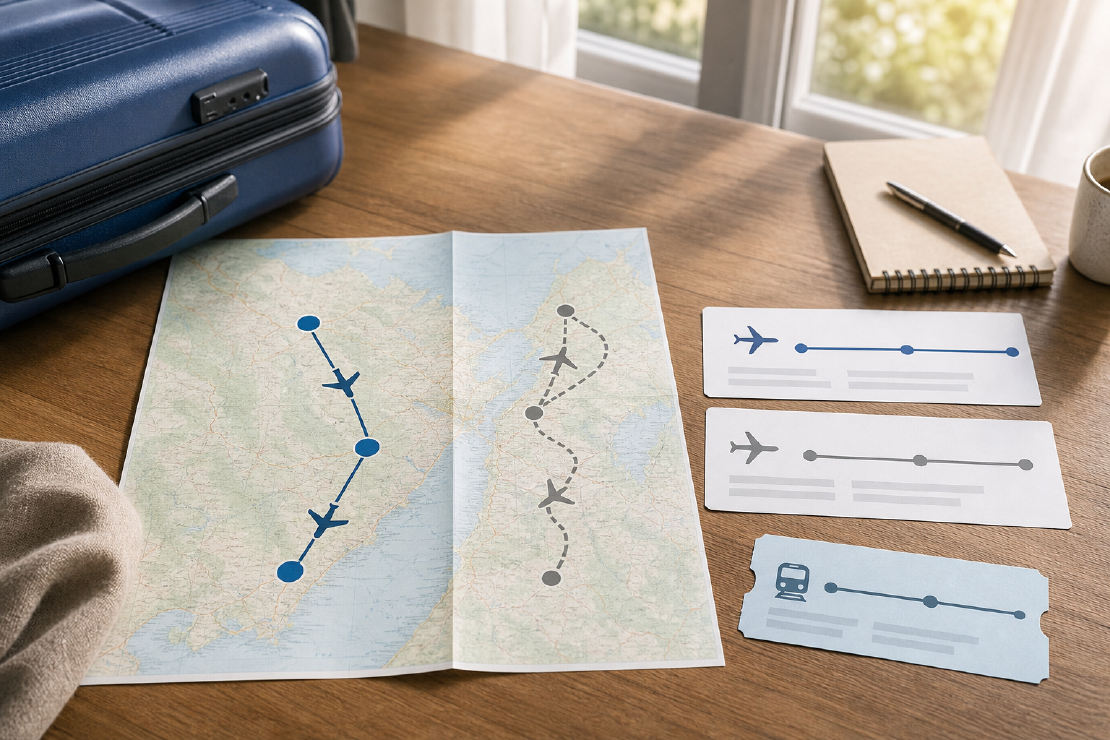
An open-jaw ticket means flying into one city and home from another. It is useful when the trip already moves in one direction. The ticket does not need to be cheaper than a normal return fare to be the cheaper trip.
An incomplete comparison might look like this:
Paris–Rome return: €180. Paris–Rome / Venice–Paris: €230. The return wins by €50.
That ignores the train back to Rome, a possible hotel near the airport, and half a day spent reversing the itinerary. Compare the finished journey, not the first number on the flight screen.
Use open-jaw for a linear trip
Open-jaw works best when the route naturally ends far from where it started:
- Rome to Florence to Venice;
- Tokyo to Kyoto to Hiroshima;
- Marrakech to Fez to Tangier;
- a road trip where returning the car in another city is affordable;
- a long overland route across more than one country.
It is less useful on a compact trip with one base, or when the second airport has limited international service. Using two airports only helps when it improves the complete itinerary.
Compare the complete cost
Build both versions before choosing.
| Cost | Return ticket | Open-jaw ticket |
|---|---|---|
| International flights | Include bags and payment fees | Include bags and payment fees |
| Final backtrack | Train, bus, fuel or domestic flight | Usually none |
| Airport transport | At the original arrival city | At the final city |
| Extra hotel | Possible before an early return flight | Possible before the open-jaw flight |
| Car one-way fee | Usually none | Sometimes expensive |
| Lost usable time | Often the main hidden cost | Usually lower |
Time matters when the backtrack removes something useful: a full afternoon, the only realistic connection or the margin before a long-haul flight. Include it in the comparison when it changes the practical value of the itinerary.
Return vs open-jaw cost worksheet
Enter prices in one currency and include the costs created by each itinerary, not only the headline airfare.
The result compares entered cash costs. Consider lost usable time, connection protection and one-way car-rental restrictions separately.
The calculation runs locally in your browser. No itinerary or price is transmitted or stored.
Run the comparison again if flight times change. A lower fare can stop being the lower-cost itinerary when it introduces an overnight stay or an airport transfer.
Search it as one itinerary
Use the multi-city option and search both international legs together. A single multi-city booking may price differently from two one-way tickets, especially on long-haul airlines.
Then compare:
- a normal return;
- the open-jaw itinerary on one booking;
- two independent one-way tickets;
- one long-haul ticket plus a separate regional flight, only if the connection risk is acceptable.
Keep the cabin and baggage conditions equal. A return fare with a checked bag is not comparable to an open-jaw fare that charges for the bag twice.
Check the second airport properly
The final city may have an airport without having a useful flight home. Check:
- whether the flight operates on the required day;
- whether it uses a distant secondary airport;
- departure time and the first public transport connection;
- seasonal routes that disappear outside summer;
- whether the proposed itinerary is protected or uses separate tickets;
- baggage rules on any regional feeder flight.
A 06:00 departure can create a taxi and hotel cost. A connection requiring an airport change can erase the time saved by avoiding the backtrack.
Watch one-way car-rental fees
Road trips are a common open-jaw use case, but the rental-car fee can decide the calculation. Domestic one-way rentals may be reasonable, while international drop-offs can be very expensive or unavailable.
Price the exact car category, dates and drop-off location before buying the flights. Do not assume that because both locations belong to the same rental brand, the car can move between them cheaply.
When a return ticket is still better
Choose the return when:
- the route is circular rather than linear;
- the open-jaw fare is much higher after all costs;
- the final airport has unreliable or awkward service;
- a one-way rental surcharge destroys the saving;
- the backtrack is a pleasant, direct train rather than a logistical problem;
- returning to the first city creates a useful final night instead of dead time.
An open-jaw ticket is a routing tool, not a travel hack. It wins when it removes an actual weakness from the itinerary.
A quick decision rule
Calculate:
open-jaw premium − avoided transport − avoided hotel − avoided baggage or transfer costs
If the result is small and the open-jaw route removes a fragile connection or a wasted day, it is usually the cleaner choice. If the result is large and the backtrack is easy, buy the return.